
Recentemente fiz um post (aqui) sobre o relançamento da decoração Willow pela Oxford, agora sob a marca Biona.
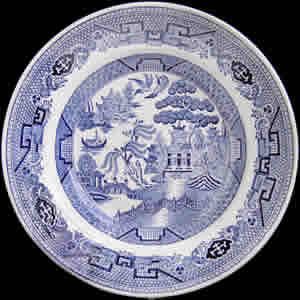
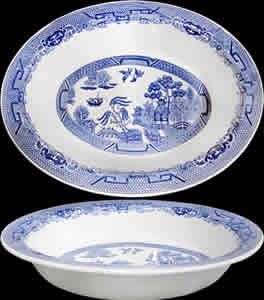
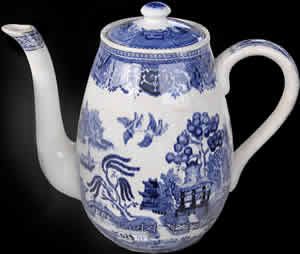
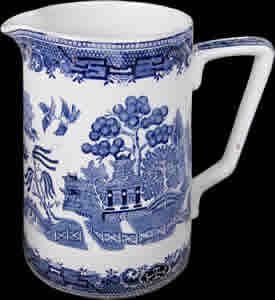
Pois bem, esta semana chegaram os meus pratos Willow!!! Eles foram comprados diretamente da loja de fábrica da Oxford (loja@oxfordporcelanas.com.br).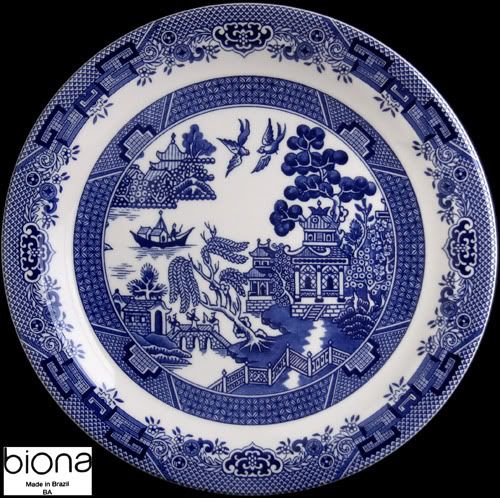
Estou muito feliz por finalmente ter um pequeno jogo de lanche com este padrão que eu curto tanto (mesmo sendo um grande clichè, mas quem leu meus posts sabe que eu tenho uma razão concreta afetiva para gostar de louça Willow).
Mostrando postagens com marcador azul pombinho. Mostrar todas as postagens
Mostrando postagens com marcador azul pombinho. Mostrar todas as postagens
pratos Willow Oxford/Biona

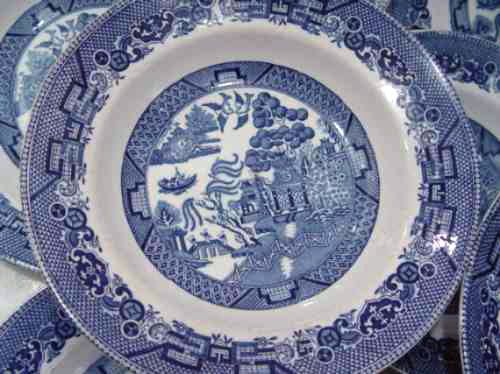
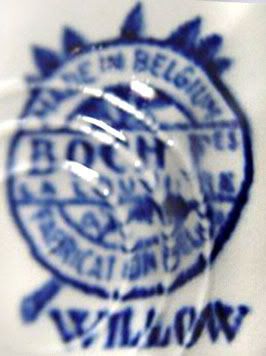
e uma vez mais... willow!
Atualizando um post que fiz há um certo tempo, em que contava que havia conseguido 4 xícaras de chá Willow da Oxford, déc. 1990, e queria completar o jogo: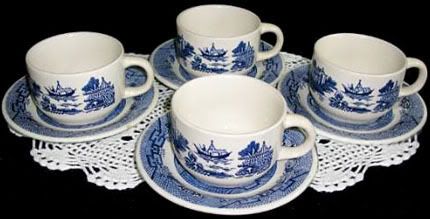
http://porcelanabrasil.blogspot.com/2010/01/e-mais-willow.html
Qual não foi a minha surpresa ao consultar a Oxford para ver se por acaso ainda havia peças avulsas sobrando na loja de fábrica, e descobrir que eles estavam para relançar EXATAMENTE ESTA DECORAÇÃO este ano, pela marca Biona!!
Pois bem, finalmente está no mercado. Mas para a minha decepção, apenas como JOGO COMPLETO, e eu quero apenas 4 pratinhos... 

Acho que agora é esperar para ver se na loja de fábrica haverá peças avulsas para reposição. Será que preciso ligar lamentando que os QUATRO pratos de sobremesa do jogo recém comprado cairam no chão e se espatifaram, para convencê-los a me vendar APENAS os pratinhos?...
variação do "Willow"?
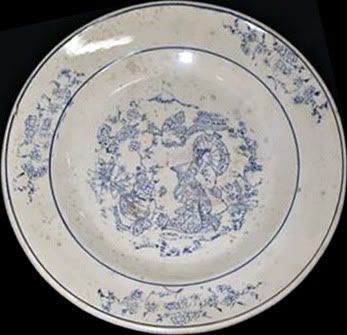
O prato abaixo, fabricado pela Cerâmica Miranda Coelho (1954/1964), apresenta uma decoração feita com transferware azul cobalto com motivos orientais.

Se olharmos com mais atenção, veremos que na verdade trata-se parcialmente do padrão "Willow", ou "Azul Pombinho" como preferem aqui no Brasil, só que espelhado.
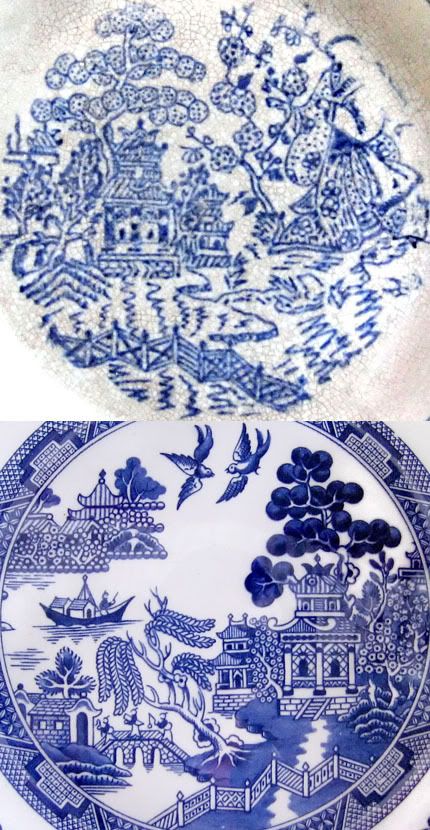
Está tudo lá: o palacete, a árvore com frutos redondos que alguns afirmam ser uma laranjeira, a grade em zigue-zague.
Curiosamente, ou mesmo, sintomaticamente, o "willow" (salgueiro) em si sumiu, bem como outro símbolo paradigmático do padrão: o casal de aves. Além destes, tudo o que está à esquerda do padrão "Willow", que seria a continuação da história, foi substituido por uma mulher de quimono GIGANTE, ao lado de uma cerejeira em flor, absolutamente desproporcional ao resto do motivo, como se fosse uma simples "colagem" de dois desenhos independentes em um único:
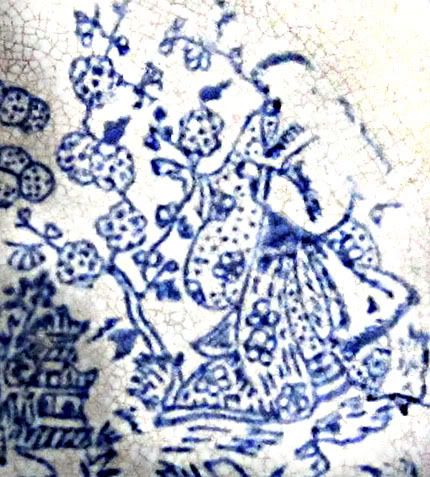
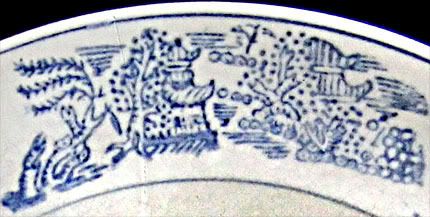
Para completar, um detalhe do motivo decorativo da borda do prato:
Existe um padrão inglês derivado do "Willow", que também é praticamente apenas um espelhamento do padrão mais famoso, chamado "Broseley", mas neste além do palacete estar muito ampliado, tornando-se praticamente o elemento principal do motivo, quase tudo mais do padrão "Willow" está lá, exceto pelo casal de aves:
Infelizmente não consegui descobrir ainda se o desenho impresso no prato do início deste post foi uma criação da Miranda Coelho, ou se foi importado.
A Miranda Coelho usava ao menos mais dois padrões orientais, também em transferware azul cobalto.
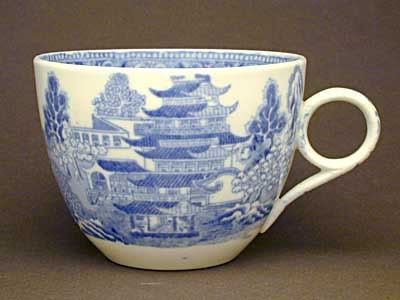
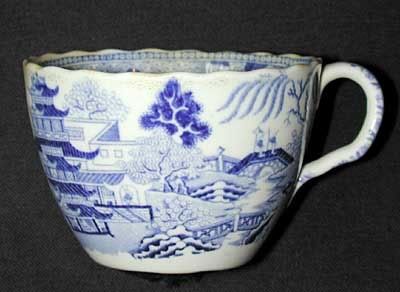
O primeiro, abaixo, eu só vi até hoje aplicado em xícaras, mas que não vejo razão para não ter sido usado em outras peças também. Este padrão não é como o anterior, uma variação do Willow, mas apresenta um salgueiro, que é um símbolo muito usado em decorações orientais legítimas, ou inspiradas no oriente.
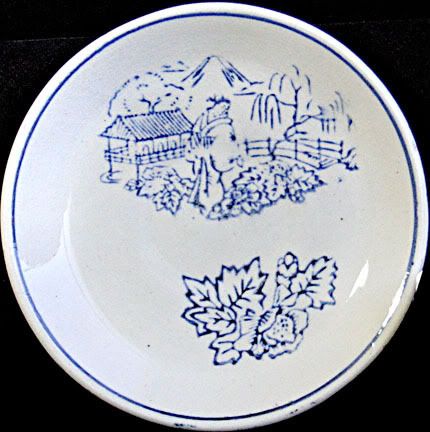
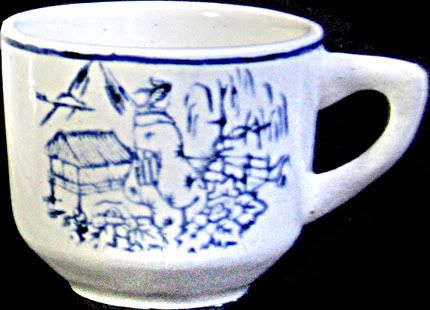
Neste, além do salgueiro, há também uma mulher de quimono em meio a flores e folhagens, um monte, uma construção mais simples, e uma cerca entre a área da construção e do jardim onde está a mulher de quimono, e o fundo da cena.
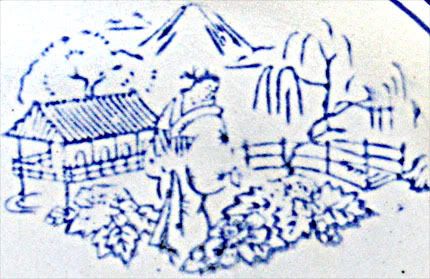
O outro padrão apresenta a mulher de quimono no jardim, desta vez muito mais detalhado, com o monte ao fundo, mas me parece que não há aqui o salgueiro. A foto está muito ruim, pois foi obtida em um site de leilões. Há também uma construção, agora no alto, à direita. Não há a cerca do padrão anterior.
É interessante pensar se a razão de tantos padrões orientais usados por uma fábrica de portugueses e brasileiros, em plenas décadas de 1950 e 60 seria o reflexo do mercado. De fato há várias fábricas de louça e de porcelana neste mesmo período que usaram exaustivamente motivos orientais em suas decorações, mas sempre em decalques policrômicos.
O transferware azul, um tanto simples, quase tosco, talvez tenha sido uma maneira mais barata de tentar seguir uma moda vigente. Com algumas exceções de peças decoradas com decalques florais ou cenas românticas e filetes dourados, a maioria das peças Miranda Coelho já observadas apresentam decorações bastante simples, quase rudimentares, feitas por estanhola, sempre em azul cobalto, ou meros filetes de verniz colorido.
Estanhola, transferware e simples filetes são soluções bem mais baratas do que o uso de decalques e ouro, mas que parecem muito anacrônicas com o que acontecia em praticamente todas as demais fábricas da época. Estaria a Miranda Coelho presa a um modelo antigo, como uma inércia produtiva da fábrica, ou simplesmente visava um mercado mais popular (sua louça estava longe de ser uma das mais finas e bem acabadas...)? É algo ainda por se descobrir.
Willow hispano-americano
Ontem a simpática leitora deste blog, Jeanine Faria, me enviou foto de uma travessa fabricada no Uruguai com decoração Willow, que ela encontrou no site Mercado Livre de lá. 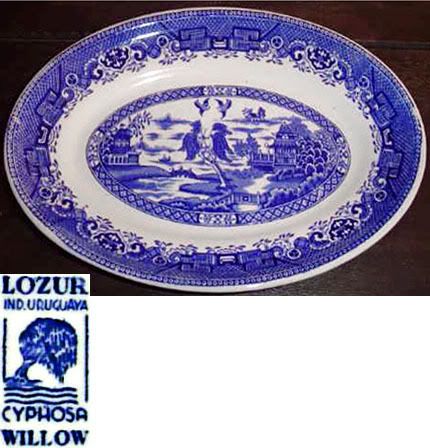
Eu conferi o site, e vi que há mais peças Willow desta marca uruguaia à venda. O curioso foi constatar que vários dos Willows à venda no site são da Oxford (Brasil). Um país que por mais de um século importou quantidades imensas de Willow inglês, passou a exportador da decoração.
Isso me lembrou que há anos salvei uma foto de um Willow argentino, que ao invés do tradicional azul, era em vinho.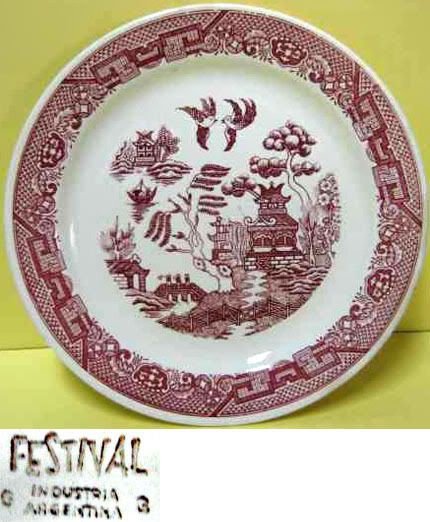
Tentei achar louça Willow no site Mercado Livre de outros países hispano-americanos, mas sem sucesso.
Mas mesmo que à princípio só haja Willow fabricado nas Américas no Brasil, Argentina, Uruguai e EUA, é impressionante a força que esta decoração teve tanto no mundo antigo, quanto no novo mundo! Acho que nenhuma outra decoração chegou perto, ou mesmo longe, de tamanha popularidade.
O curioso, e um tanto bizarro, foi encontrar no Ebay americano várias peças decorativas novas com a decoração Willow, com a forma de animais que nada tem a ver com a "lenda" do Willow! Vacas, galinhas, gatos, elefantes, coelhos, cofre-porquinho e o que mais vocês imaginarem,
além de diversos bibelots miniaturas também com decoração Willow, como mesinhas, bules, cadeiras, vasinhos, etc.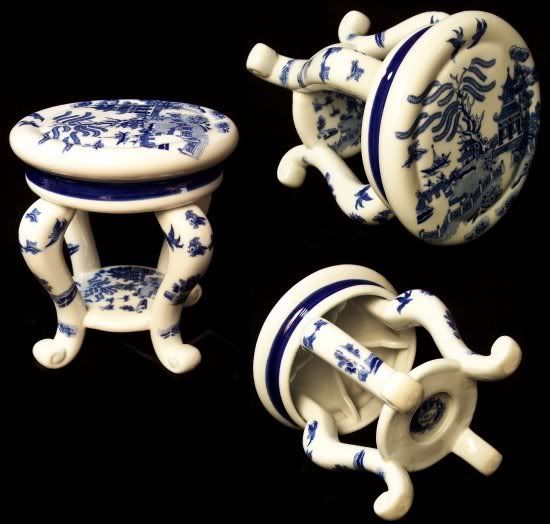
Infelizmente não consegui identificar a procedência destas peças (nenhum dos anúncios informa este detalhe); apenas consegui ler "Stoneware LCA warranted" na marca de uma das peças (são todas desta mesma marca).
e mais Willow...
Há talvez 2 ou 3 semanas vi em um filme uma mesa posta com um serviço Willow, padrão que adoro (explico a razão mais à frente), e fiquei obcecado em montar um pequeno jogo neste padrão para meu uso. Isto não seria difícil pois a Oxford ainda tinha este padrão em catálogo até finais da década de 1990.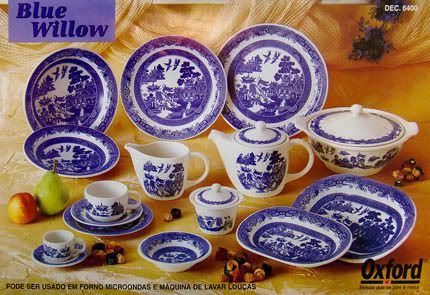
decoração Willow da Oxford; catálogo de 1996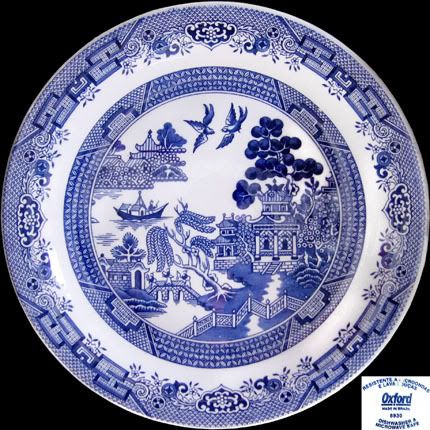
prato Willow da Oxford
Tenho algumas peças Willow inglesas e brasileiras antigas, mas estas não coloco em uso pois além do risco de quebrar, são de faiança, o que sabemos que não é muito higiênico, principalmente depois de tantas décadas.
prato de sobremesa Cerâmica Matarazzo, da minha coleção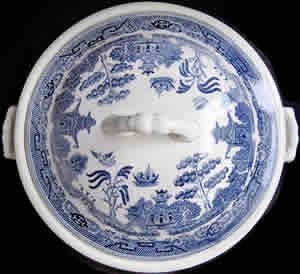
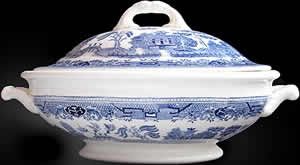
legumeiro Cerâmica Matarazzo, da minha coleção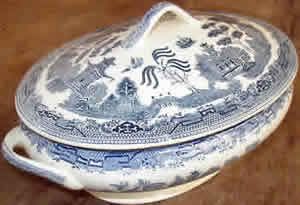
sopeira Cerâmica Matarazzo (coleção particular, SP)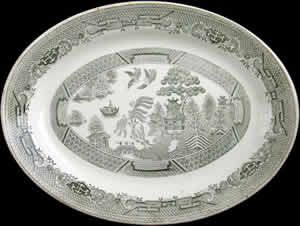
travessa Cerâmica Matarazzo, em verde, da minha coleção
Já consegui 4 xícaras Oxford fabricadas em 1997, e agora quero bule, açucareiro, mantegueira, pratos, etc.
Enfim, por conta desta paixão renovada pelo Willow, fiz aqui vários posts sobre o padrão, descobri um ótimo blog português chamado "Velharias" (velhariasdoluis.blogspot.com), onde aprendi sobre o Cantão Popular, uma variação do padrão Willow criado nas antigas fábricas portuguesas de faiança (leia aqui), publiquei também algumas coisas sobre o padrão Willow aqui neste blog, em seguida uma amiga, dona do delicioso Brechó Charisma, estimulada pelos meus posts, fez também um sobre o padrão no blog dela (veja aqui), agora no blog "Velharias" apareceu um novo post sobre o padrão Willow em portugal (veja aqui)... Acho que estamos incendiando novamente o desejo pelo padrão!
O mais curioso é que descobri que na coleção que será lançada este ano pela Oxford, a decoração Willow retornará, para atender uma demanda de mercado pelo padrão que ainda existe !! Em 2010 ainda há pessoas desejosas de comprar um serviço Willow!! Um padrão criado no século 18, chega ao 21 ainda com fôlego.
Parece-me então que este desejo pelo Willow está pelo ar. Será mais um destes momentos de escapismo, quando as coisas não estão bem pelo mundo, e que corremos para nos refugiar na nostalgia?
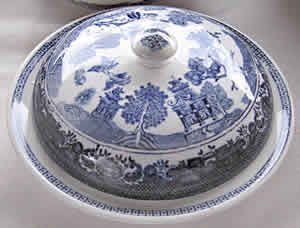
Este padrão eu aprecio desde pequeno, pois na casa de minha avó paterna havia um jogo grande, até com uma enorme sopeira octogonal com pegadores em formato de cabeça de porcos, que para mim sempre foi uma peça misteriosa e encantadora. Achei na internet uma foto de uma sopeira parecida com a que havia no jogo de minha avó: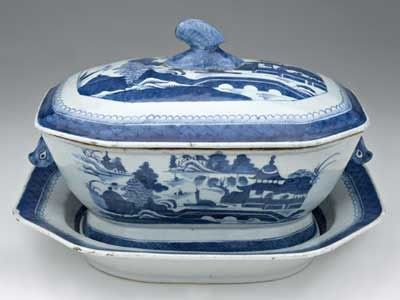
Este jogo era japonês, minha avó o ganhou de uma amiga, vizinha de porta, quando esta foi obrigada a deixar o Brasil, por ocasião da 2a Guerra Mundial.
Infelizmente este jogo foi se quebrando ao longo das décadas de uso, e quando minha avó morreu, as poucas peças restantes foram espalhadas pela família, e eu não fiquei com nenhuma, pois ainda não me preocupava com isso na época.
Aproveito então este post para ilustrar outras peças "Willow", ou "Azul Pombinho", como se costuma chamar este padrão no Brasil, de fabricação nacional, tanto peças que reproduzem este padrão de forma mais exata, bem como as incríveis variações simplificadas, feitas com estanhola, pelas antigas fábricas de louça de pó de pedra de nosso país.
Peças "Mod. Kanton", marca fantasia da Cerâmica Matarazzo:
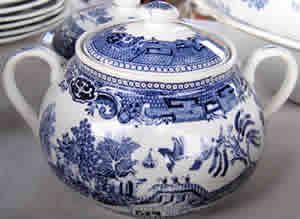
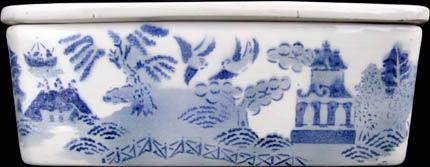
Caixa da Cerâmica Mauá: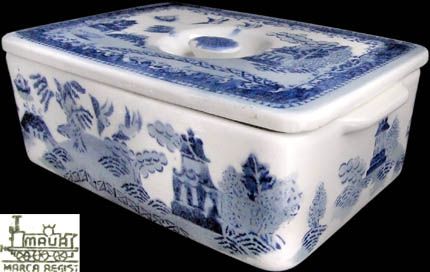
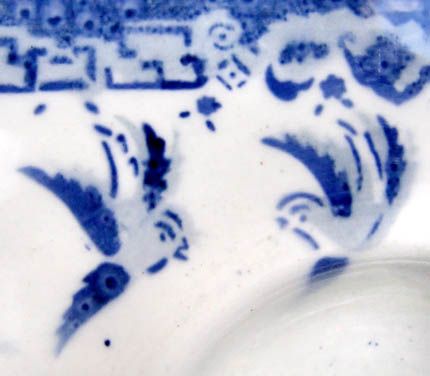
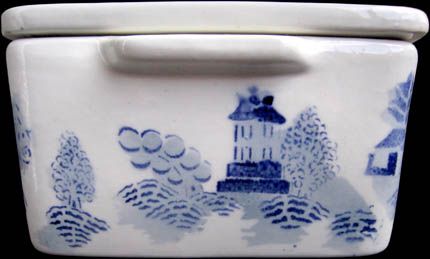
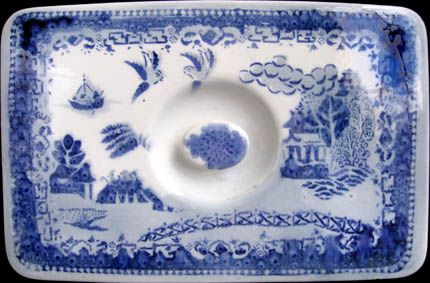
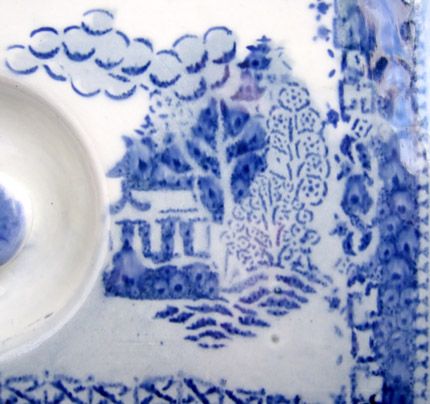
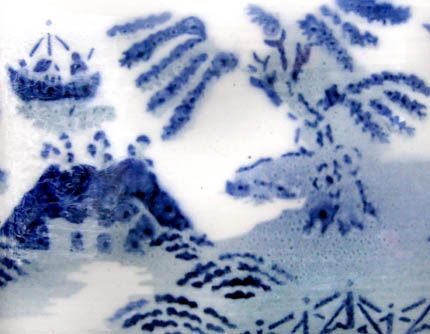
Prato da Cerâmica Campo Largo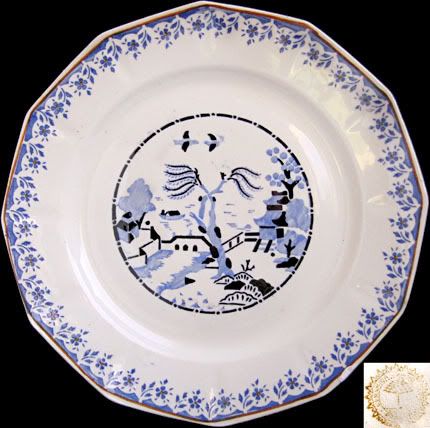
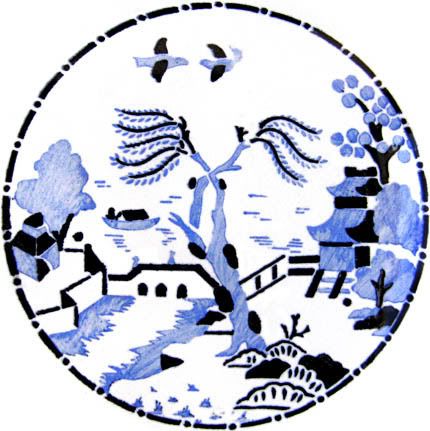
The Willow Pattern
fonte: http://www.gutenberg-e.org/haj01/frames/fhaj03.html
Earle was not the first to create a fabulous oriental tale to accompany a picture fired onto a piece of porcelain. At some point around the dawn of the nineteenth century, a spurious Chinese story developed around the famous willow pattern, even though the only porcelain bearing this exact design had its origin in England, not China. After many years and numerous mishaps, British potters in the 1780s finally produced porcelain that had the same physical properties as did the Chinese varieties. Having met Chinese standards, manufacturers next faced the challenge of crafting the appearance of their wares so that these could not only survive but ultimately flourish in a marketplace that continued to embrace Canton china. Using the popular shan shui designs as models, English porcelain designers executed landscape scenes in the Chinese style and placed these patterns on bowls, plates, and cups through a mechanical process called transfer printing. 11
Thomas Turner, working for the Caughley establishment in Shropshire in the 1780s, designed a precursor to willowware. 12 Though his creation resembled the pattern that would eventually conquer the Western world, it could not be strictly classified as authentic willow because it did not possess all of the four elements that would come to define willowware: a willow tree in the central position, three figures crossing a bridge away from the main building, a fence stretching across the foreground, and two birds hovering in the top center (fig. 2.3). 13 Thomas Minton, working for Josiah Spode’s pottery manufactory, designed the actual prototype at some later point in the same decade. 14 Despite being the first to sell willowware, Spode did not remain the sole producer for long because, shortly after the pattern’s inception, several other porcelain manufacturers obtained copies of it. 15 By the end of the 1780s, numerous porcelain factories were churning out willowware, much of it intended for the American market. 16

The British-designed willow pattern pleased American consumers for mostly the same reason as the Chinese shan shui patterns. Still, with its production in England, willowware lacked one critical attribute that had contributed heavily to the success of its Chinese competitor: the mystique and romance that origin in a distant Far Eastern country could lend to an object? Compensating for this shortcoming, a pseudo-Chinese tale evolved around the non-Chinese willow pattern. This willow legend, like the pattern that inspired it, emerged as a Western attempt to capture a Chinese essence. Whether the legend arose on its own out of the popular imagination or was the result of an ingenious marketing scheme by a British potter, one cannot say for certain. Regardless, the story proved enormously popular in England and soon migrated across the Atlantic to the United States.
The most important feature of this legend, and what contributed to its contagious appeal, was that any piece of porcelain bearing the willow pattern provided the illustrations for the narrative. In an era in which illustrated storybooks were both expensive and rare, the willow legend allowed mothers of modest means to tell a story to their children at bedtime or during meals and even show illustrations. Since the legend mutated as it moved from person to person and from one culture to the next, several versions of the legend eventually came into existence. However, all tell a romantic tale of two star-crossed Chinese lovers—a mandarin’s daughter and his lowly bookkeeper.
As the story goes, a powerful mandarin serves the emperor as the customs officer of a great seaport. His position allows him to acquire great wealth because smugglers repeatedly offer him bribes in order to avoid paying customs fees. When word of the mandarin’s corruption begins to circulate, he removes himself from his post and retires to his mansion in the countryside, taking only his accumulated wealth, a bookkeeper named Chang, and his daughter, Koong-se. Fearing an official investigation, the mandarin orders Chang to square away his books so that they can bear scrutiny. Chang loyally executes this task, only to find himself summarily discharged by the mandarin upon its completion. However, prior to his dismissal, Chang and Koong-se fall in love.
Knowing that the mandarin would never approve of the union of his daughter with a lowly bookkeeper, the two young lovers meet surreptitiously every night beneath the fruit trees, which are included in the pattern. When the mandarin learns of these clandestine trysts, he confines Koong-se to a room overlooking the river and demands that a strong palisade (pictured on all specimens of willowware) be built all around the mansion grounds to keep Chang away from his daughter. Worst of all, he also makes arrangements for her to wed Ta-jin, a wealthy duke who is her equal in status but far more advanced in age. The wedding is to take place when the peach tree blossoms (pictured). Upon hearing the news of Koong-se’s engagement, a despairing Chang realizes that he prefers death to a life without his beloved. To his lover across the river he floats a hollow coconut containing a note in which he vows to commit suicide when the buds on the peach tree open. Though greatly depressed, Chang also formulates a plan to steal Koong-se away.
One evening, Ta-jin arrives at the mansion bearing a box of jewels that he intends as a gift for his fiancée. That same night, Chang appears at the mandarin’s doorstep disguised as a beggar seeking alms. Since Chinese custom requires the wealthy to treat the poor charitably, Chang gains entrance into the house and soon finds Koong-se in her room. Down in the main hall, the mandarin and Ta-jin enjoy an evening of entertainment, food, and wine. When the latter induces sleep, Chang seizes the box of jewels and quietly leads Koong-se out of the mansion. Unfortunately, as the lovers attempt to sneak past the mandarin, he awakens, raises the hue and cry, and proceeds to pursue them himself. The two lovers flee cross the bridge as the mandarin, holding a whip, follows closely behind (pictured). It must have been one of the earliest instances of what later became known as a chase scene. 20
The lovers find a fisherman with a junk (pictured) who is willing to convey them to a nearby island, where they promptly hide in a gardener’s hut. The enraged duke, hoping to have Chang put to death for stealing both his fiancée and his jewels, deploys his spies to search the area. When the duke’s soldiers arrive on the island, Chang and Koong-se escape onto a boat and sail to another island. To support themselves, they begin to sell off the jewels one by one. But as time passes, the two realize they are safe and begin to build a new life. Chang constructs a house (pictured) and brings the land to a profitable state of cultivation. He also writes a book on gardening, and it brings him a degree of fame. As for the duke, his desire for revenge continues to smolder in his heart. And so, when the literary reputation of Chang reveals his whereabouts, the duke dispatches his soldiers to the island. Chang valiantly resists their advances but is mortally wounded in the process. Greatly distraught, Koong-se flees into the house and lights it on fire with herself inside. At this point, the Chinese gods, who are watching the tragedy unfold from on high, decide to intervene; they place a curse on the vengeful duke and take pity on the unfortunate lovers. As is pictured in the pattern, they turn Chang and Koong-se into kissing doves just before they perish. 17
With the willow legend, mothers captivated their juvenile audiences by projecting a narrative of love, danger, and adventure onto a make-believe Chinese landscape. And the tremendous popularity of this legend had the effect of creating a vogue for willowware. Since supply in England was able to keep pace with demand in the United States, cups, bowls, plates, and saucers bearing the design soon flooded American society. Ada Walker Camehl, who collected china around the dawn of the twentieth century, found plenty of willowware even out in rural areas of the United States. 18 To the porcelain connoisseur Warren Cox, the proliferation of willowware occurred to the detriment of good taste: “Nothing could better exemplify the utter dearth of aesthetic consciousness than the stupid copying of this design which lacks every element of true Chinese painting and any real claim to beauty whatsoever, and the maudlin stories wrought about it to please the sentimental old ladies of the late eighteenth century.” 19
The “maudlin stories” to which Cox referred are of course the willow legend in its myriad permutations. The story became such an integral part of American folklore that it even found its way into verse. In fact, along with the usual nursery rhymes, a poetical version of the story was commonly recited to children by their mothers:
So she tells me a legend centuries old
Of a Mandarin rich in lands of gold,
Of Koong-Shee fair and Chang the good,
Who loved each other as lovers should.
How they hid in the gardener’s hut a while,
Then fled away to the beautiful isle.
Though a cruel father pursued them there,
And would have killed the hopeless pair,
But kindly power, by pity stirred,
Changed each into a beautiful bird.
Like any retelling of the willow legend, this poem was clearly designed to be repeated in the presence of a piece of willowware, because it points out the various elements in the pattern that correspond to specific moments in the story: “Here is the orange tree where they talked, / Here they are running away, / And over all at the top you see / The birds making love always.” 20 25
Henry Wadsworth Longfellow also fell under the magical spell of the willow pattern in his childhood years. However, he did not require the legend to fire his imagination, because the image by itself was sufficient to transport him to an imaginary world. The willow pattern that “we knew / In childhood,” he wrote, enabled these “coarser household wares” to transcend their purely utilitarian function. With “its bridge of blue / Leading to unknown thoroughfares,” the willow pattern offered a portal to an enchanted world where one could observe the “solitary man,” the “white river,” the “arches,” and the “fantastic trees.” So different, novel, and powerful, the willow pattern made an unmistakable impression on the imaginative Longfellow and others like him; it either “filled us with wonder and delight” or “haunted us in dreams at night.” 21
Another poem on the subject suggests that many people actually believed that both willowware and the romantic willow legend came from China, not England. And as the poem indicates, these mistaken origins played an integral role in transforming the dining experience in nineteenth-century America:
My Willow ware plate has a story,
Pictorial, painted in blue,
From the land of the tea and the tea plant
And the little brown man with a queue.
Whatever the food you serve, daughter,
Romance enters into the feast,
If you only pay heed to the legend,
Of the old chinaware plate from the East. 22
Since the story sounded Chinese and the design looked Chinese, the willow pattern and the accompanying legend had the combined effect of masking the true origin of the porcelain—just as the English producers had hoped it would. Many Americans who believed that this spurious Chinese legend was authentic told it at the dinner table to imbue an otherwise quotidian meal with the romance and exoticism associated with China. 23 In this way, an ordinary meal could take on an ersatz Far Eastern splendor: “Romance enters into the feast.” Since any revelation of willowware’s true origin threatened to spoil the enjoyment, Americans tended to consider all blue-and-white porcelain as Chinese and could become testy when apprised of a piece’s true English roots. 24 The willow pattern and the accompanying legend achieved such ubiquity in American life that one must consider their pervasive influence if seeking to understand how an idealized vision of China of permeated Americans’ thinking in the early nineteenth century.
Note 11: Whereas all Chinese ceramics were hand-painted, the British employed this mechanical technique. A design engraved on copper was printed onto a piece of tissue paper, which was then transferred onto the ceramic object. Crosby Forbes, preface; Davis, 119.
Note 12: Copeland, 4.
Note 13: Geoffrey Godden, “The Willow Pattern,” Antiques Collector (June 1972): 148–50.
Note 14: Copeland, 33.
Note 15: It was a common practice both for potters to lend engravings to one another and for successful factories to purchase the master patterns belonging to potters who were selling their businesses. Copeland, 4.
Note 16: As a sign of the increasing success of the British industry, Charles Tyng reported that in 1821 his ship used stones for ballast, whereas in 1815 the practice had been to use Chinese porcelain: “China ware was no longer shipped, the English ware having taken its place.” Fels, 75.
Note 17: Harry Barnard, The Story of the Wedgwood Willow Pattern Plate (Hanley, England: Catalogue Printers), 2–7. Josiah Wedgwood and Sons published this guide book to Wedgwood porcelain.
Note 18: Ada Walker Camehl, The Blue-China Book: Early American Scenes and History Pictured in the Pottery of the Time (1916; reprint, New York: Dover, 1971), xxvii.
Note 19: Cox, 768–69.
Note 20: In this version of the story, the father, not the duke, finds the lovers on the island. Camehl, 287.
Note 21: Longfellow composed “Kèramos” in 1877 and first published it in Harper’s. The Works of Henry Wadsworth Longfellow, ed. Samuel Longfellow (Boston: Houghton, Mifflin, 1886), 3:231–32. Another American author, Nathaniel Hawthorne, viewed a porcelain “China tea-set” as strange but intriguing. In The House of Seven Gables (1851), he described it as “painted over with grotesque figures of man, bird, and beast, in as grotesque a landscape . . . a world of vivid brilliancy” ([Oxford: Oxford University Press, 1991], 76–77).
Note 22: Quintner, 152.
Note 23: Perhaps realizing that Americans preferred to think of the willow legend as of Chinese origin, the Buffalo China Company, the first American pottery company to produce willowware, misinformed potential customers in its 1905 catalog: “The legend illustrated by the Blue Willow ware decoration is centuries old. It originated in China and forms a love story so alive with human interest that it never grows old.” Quintner, 128. Similarly, Ada Walker Camehl wrote that what she believed was a Chinese story had inspired Thomas Minton to make the original willow pattern. Camehl, 287. Finally, Amy Carol Rand, in an article instructing women how to design table linen using the willow pattern, also wrote under the misconception that the pattern was Chinese in origin (The Modern Priscilla [July 1910], 4).
Note 24: Earle, 181–82.
pombinhos ingênuos - II
Ontem, na feira da praça XV, fiz uma LOUCURA (para os meus padrões baixa renda...)
Comprei uma caixa grande da Cerâmica Mauá, com decoração Willow feita com estanhola!
Eu já havia visto uma peça destas, na coleção de um colaborador aqui do Rio, e fotos enviadas pela minha boa amiga Bernardete (veja neste post>>).
Mês passado apareceu uma caixa como esta na feira da praça XV, mas o vendedor queria o "módico" valor de... R$ 350!!!. Irrealístico!
Pois bem, ontem quando cheguei na banca do Pedrinho (um dos vendedores mais gente-boa aqui no Rio, um cara incrível, um tipo de pessoa que praticamente não existe mais, tranquilo, super amigável, generoso, sempre disposto a ajudar, entre outras qualidades), havia esta caixa da foto acima, linda, branquinha, sem um lascadinho sequer, sem nenhuma mancha, não deve ter sido jamais usada nos seus 60 anos de vida.
Ele queria R$ 160 na caixa, mas deixou para mim por R$ 130. Comprei, sem pensar duas vezes!! A peça mais cara que havia comprado até hoje tinha custado R$ 60. Se fosse em outro vendedor, teria deixado passar, mas sendo com o Pedrinho comprei. Ele já vendeu diretamente 8 livros meus, e já deve ter influenciado indiretamente a venda de tantos outros, pois sempre faz muita propaganda do mesmo, e sempre se recusou a receber qualquer tipo de comissão.
Foi uma pequena "loucura", pelo valor, mas considero que foi meu auto-presente de Natal, e eu tenho um carinho especial pelo padrão Willow, mesmo sabendo que é um mega-cliché neste mercado de antiguidades, mas a decoração Willow lembra minha infância, a casa da minha avó, que tinha um jogo de jantar Willow que ganhou de presente de uma grande amiga vizinha sua, que teve que deixar o Brasil na época da Segunda Guerra Mundial, apenas por ser japonesa.
Meu único "medo" é abrir um precedente para peças nesta faixa de valor, que até então era uma "regra de ouro" para mim!
Mas eu acho que todos merecemos nos permitir uns pequenos luxos.
Assinar:
Postagens (Atom)